A star-shaped light pattern (often 4 or 6 rays) produced by oriented inclusions; typically visible on cabochon-cut stones and used as a descriptive/valuing feature.
Double refraction where light splits into two rays, sometimes producing doubled edges through transparent crystals; an optical clue tied to crystal structure.
A moving ‘cat’s‑eye’ band of light caused by aligned fibers or needle-like inclusions; commonly seen on cabochons and used to describe gemstone appearance.
Bands or patches of different color within one crystal caused by changing growth conditions or chemistry; reveals growth history and can affect appearance and value.
A visible glow under UV light (longwave/shortwave) caused by trace activators in the mineral; useful for identification and for evaluating fluorescent specimens.
A change in color or intensity when a crystal is viewed from different directions (often with polarized light); a diagnostic optical trait in some minerals and gems.
How much light passes through a specimen—transparent, translucent, or opaque—used for identification, grading, and deciding on lighting for display or photography.
Cart
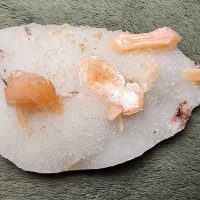
“Bowtie Stilbite Crystals on Chalcedony from Jalgaon District, Maharashtra, India” has been added to your cart. View cart