Applying dilute acid to see if a mineral fizzes (effervesces), indicating carbonate content; commonly used to distinguish calcite and other carbonates from look‑alikes.
A star-shaped light pattern (often 4 or 6 rays) produced by oriented inclusions; typically visible on cabochon-cut stones and used as a descriptive/valuing feature.
Double refraction where light splits into two rays, sometimes producing doubled edges through transparent crystals; an optical clue tied to crystal structure.
A moving ‘cat’s‑eye’ band of light caused by aligned fibers or needle-like inclusions; commonly seen on cabochons and used to describe gemstone appearance.
A mineral’s tendency to break along flat, repeating planes controlled by its crystal structure; used to recognize species and predict how a specimen will split.
Bands or patches of different color within one crystal caused by changing growth conditions or chemistry; reveals growth history and can affect appearance and value.
A visible glow under UV light (longwave/shortwave) caused by trace activators in the mineral; useful for identification and for evaluating fluorescent specimens.
Internal crystals, fluids, fractures, or growth features trapped inside a mineral; used to interpret formation conditions and to judge clarity, stability, and aesthetics.
How a mineral reflects light from its surface (metallic, vitreous, pearly, etc.), a quick visual property collectors use to narrow identification and describe specimens.
A check for attraction to a magnet (or effect on a compass), which quickly flags strongly magnetic minerals like magnetite and some weakly magnetic species.
Cart
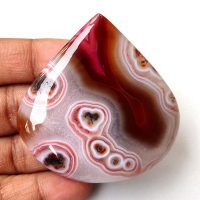
“Texture Pink Onyx Agate Cabochon Heart Shape Natural Gemstone 241 Cts” has been added to your cart. View cart